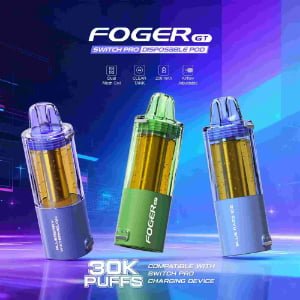

If you vape, you've probably wondered where your device actually comes from. The answer might surprise you — or maybe it won't.
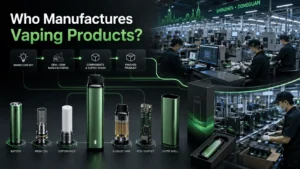
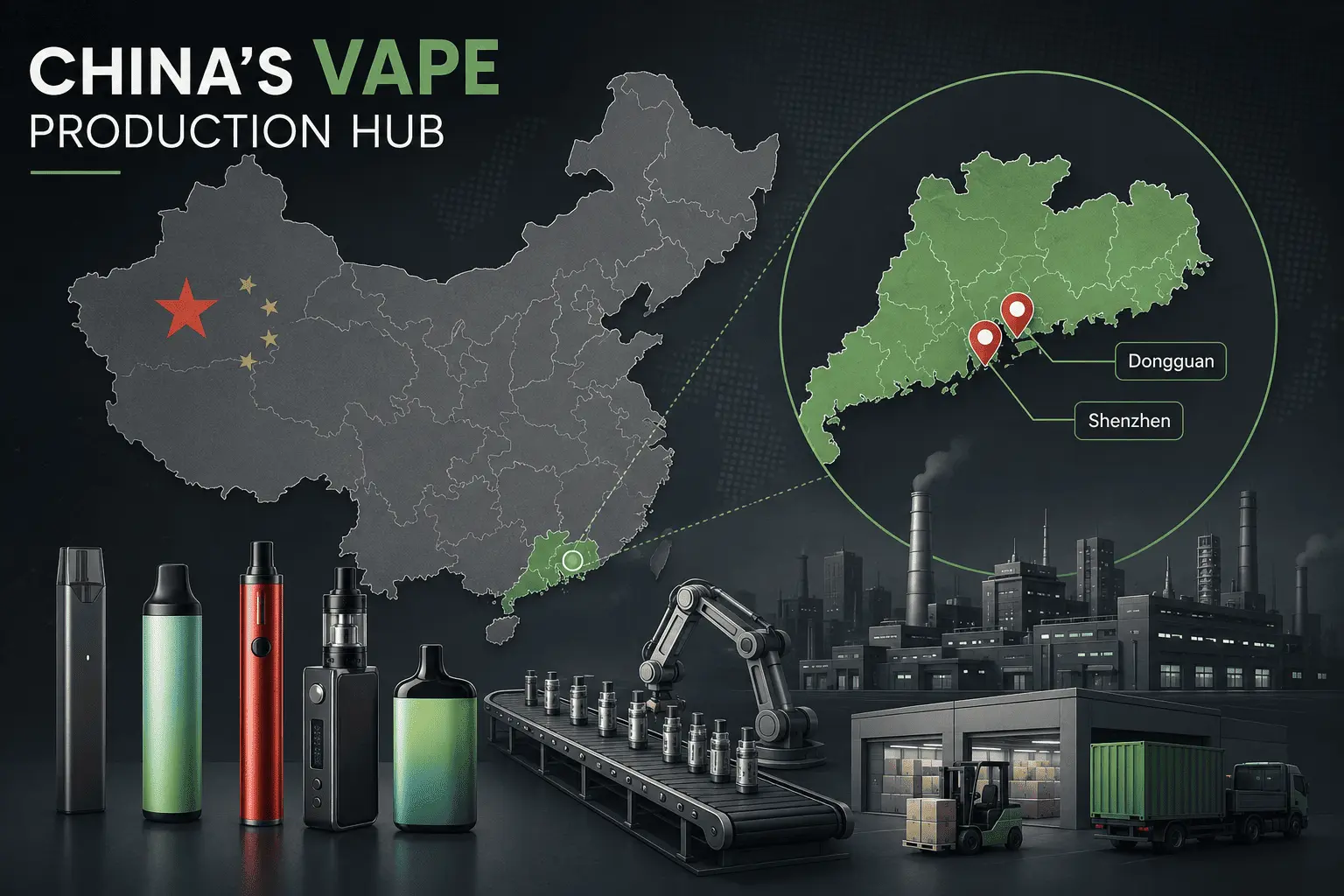
China is the biggest producer of vapes in the world.1 Most vape manufacturing is concentrated in two cities: Shenzhen and Dongguan. These two cities house the majority of the world's vape factories2, producing everything from disposable vapes to advanced vape kits and e-liquids.
I've been in this industry for over 13 years. I've watched it grow from a niche market into a global phenomenon. And through all that change, one thing has stayed the same: China dominates vape production. But the story is more complex than just "made in China." Let me break it down for you.
How Did China Become the Biggest Vape Producer?
China's vape industry didn't happen overnight. It took a decade of rapid growth and a complete ecosystem of suppliers to reach this point. Today, many global retailers and distributors work with reliable vape wholesale partners to access stable supply, competitive pricing, and a wide range of products.
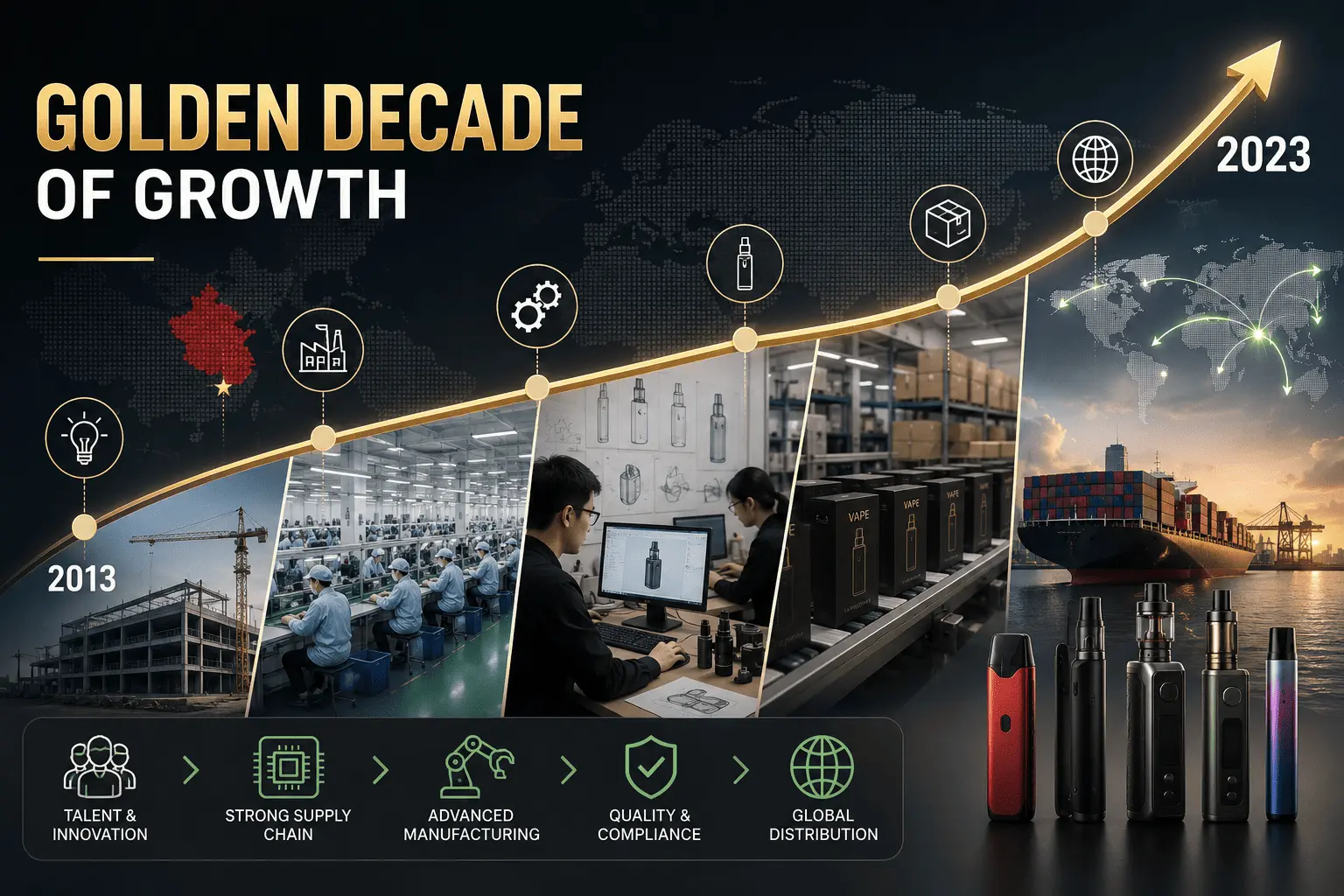
China became the biggest vape producer because it built the most complete supply chain in the world. Starting around 2013, Chinese vape manufacturers experienced a golden decade of explosive growth3, establishing deep expertise in every aspect of vape production.
The Golden Decade (2013–2022)
From 2013 onward, China's vape manufacturing sector boomed. New factories opened every week. Engineers and designers flocked to Shenzhen and Dongguan. The industry attracted massive investment.
I remember those early days. Everyone was excited. The barriers to entry were low. If you had a good idea and some capital, you could start a vape brand. Factories competed fiercely on innovation, speed, and price.
The Regulatory Shift in 2022
Things changed in 2022. The Chinese government tightened regulations significantly. Every company involved in the vape industry was required to obtain a tobacco license.4 This was a major shift.
| Period | Industry Status | Key Characteristics |
|---|---|---|
| 2013–2022 | Golden Decade | Rapid growth, low barriers, wild expansion |
| 2022–Present | Regulated Era | Tobacco license required, stricter oversight |
Some veteran vape companies that had experienced years of wild growth couldn't adapt. Some factories failed to get their production licenses. They had no choice but to leave the industry entirely and move into other sectors. The ones that survived became stronger, more professional, and more compliant. But the shakeout was real, and I saw many good people leave.
Why Does China Still Dominate Vape Manufacturing?
Even with regulations getting stricter around the world, China's position hasn't changed. The reason is simple but powerful.
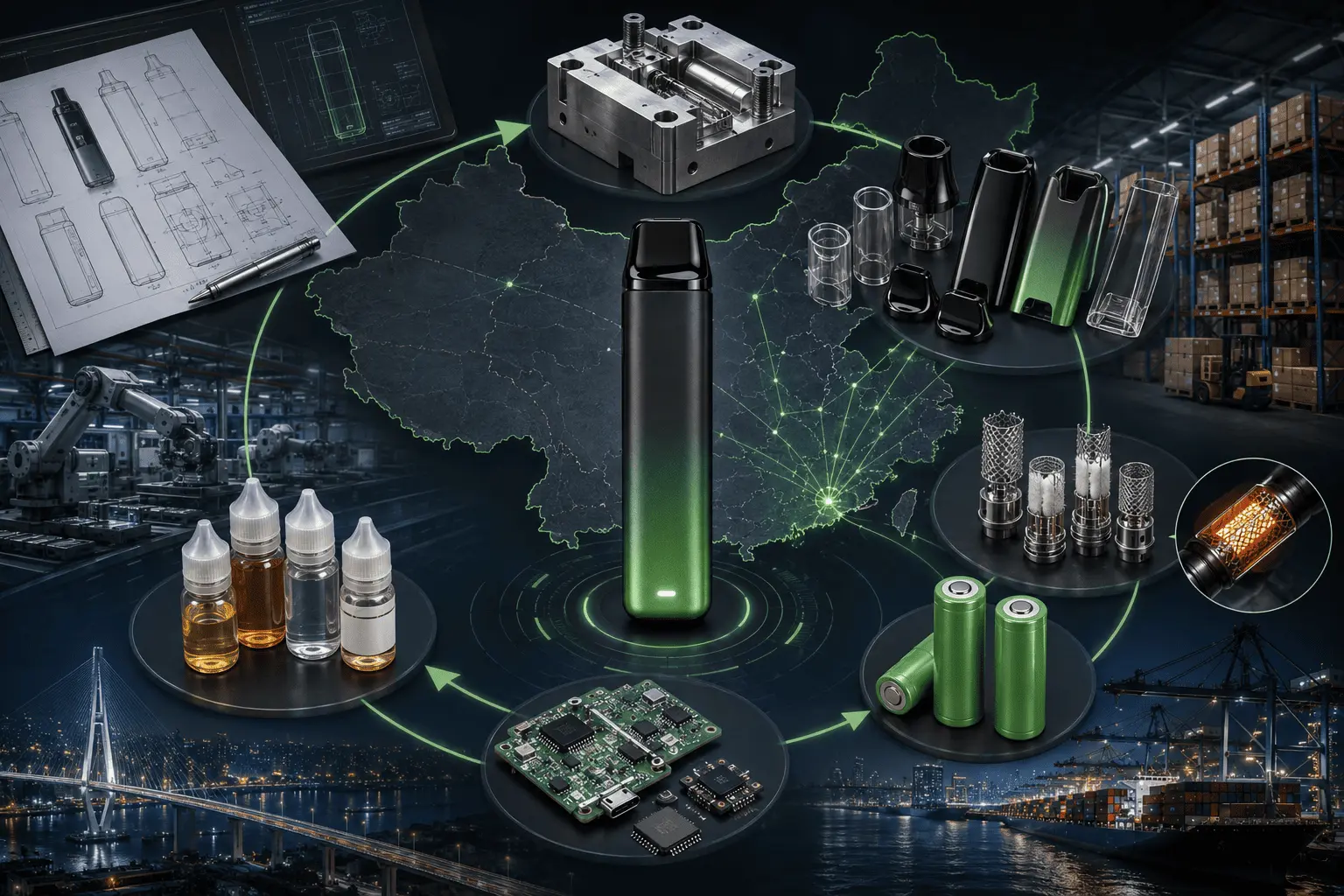
China still dominates because it has the most complete vape supply chain on Earth.5 From product design and mold making to every single component — plastics, heating coils, battery cells, and circuit boards — everything depends heavily on Chinese manufacturing.
The Supply Chain Advantage
Let me explain what "complete supply chain" actually means in practice. When a vape brand wants to create a new product, here's what they need:
| Component | Role | China's Advantage |
|---|---|---|
| Product Design | Concept and engineering | Thousands of experienced vape designers |
| Mold Making | Creating production molds | Fast turnaround, low cost, high precision |
| Plastics | Device housing and mouthpieces | Massive plastics industry nearby |
| Heating Coils | Vaporizing e-liquid | Specialized wire manufacturers |
| Battery Cells | Power source | World's largest battery producers6 |
| Circuit Boards | Device control and safety | Deep electronics manufacturing ecosystem |
| E-liquid | The vaping substance | Established flavoring and nicotine supply |
All of these suppliers are within a few hours' drive of each other in the Pearl River Delta region. This geographic concentration means faster prototyping, lower shipping costs between suppliers, and easier quality control. No other country comes close to this level of integration.
I've sourced products for years. When we need to test a new device, we can have a prototype in days. Try doing that anywhere else in the world. It's not impossible, but it's much slower and much more expensive.
Are Vape Factories Moving to Indonesia?
Yes, some are. But the reality is more complicated than the headlines suggest.
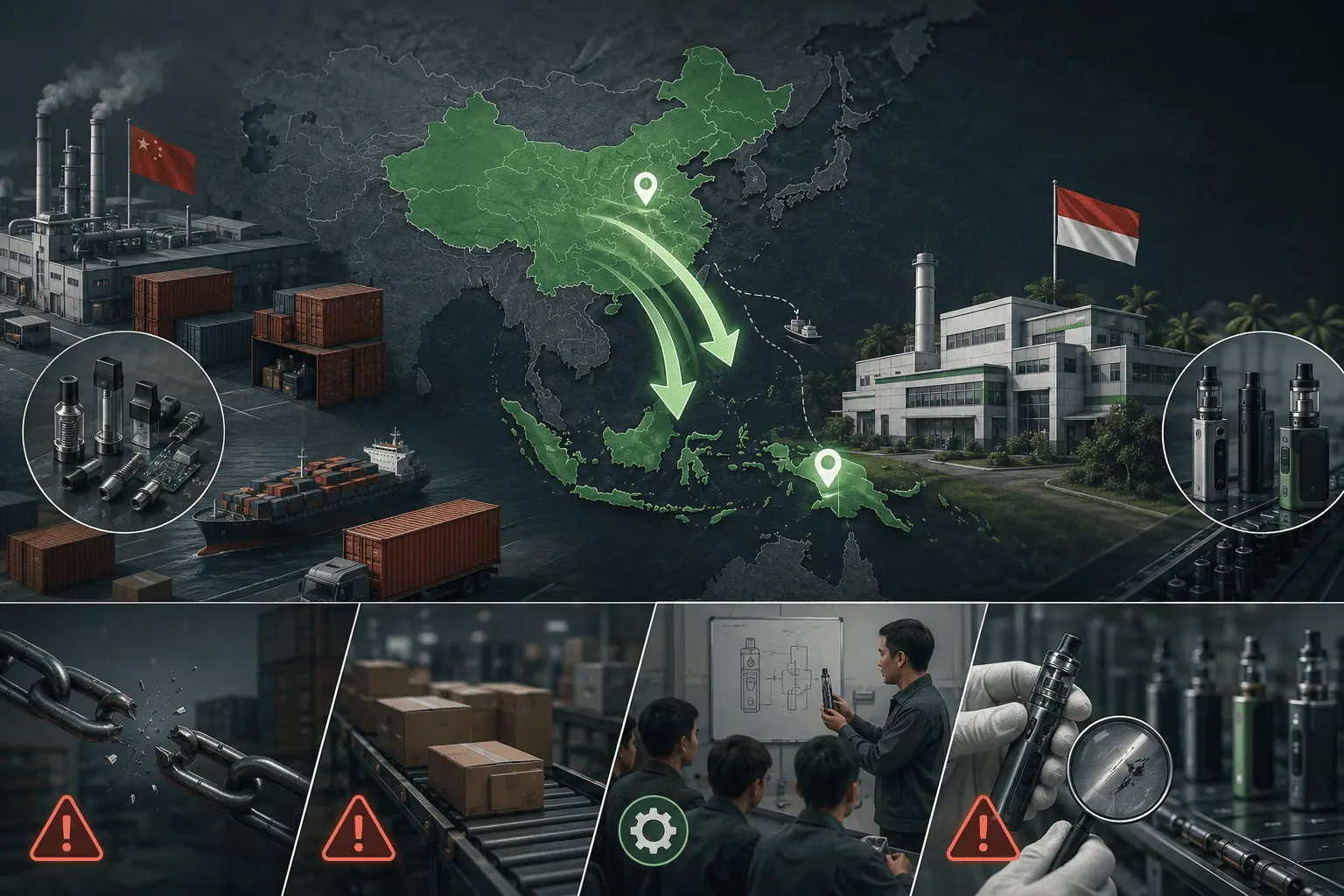
Since 2026, a wave of Chinese vape companies have relocated to Indonesia. This move is driven by US government hostility toward Chinese manufacturing and China's removal of vape export tax rebates. But these relocated factories face serious challenges.
Why Companies Are Moving
Two main factors pushed Chinese vape manufacturers toward Indonesia:
- US tariffs and political pressure — The US government has shown increasing hostility toward Chinese-made products. Higher tariffs make Chinese vapes less competitive in the American market.
- Loss of export tax rebates — China cancelled the vape export tax rebate policy.7 This directly increased costs for Chinese manufacturers selling overseas.
Indonesia offered a solution: lower labor costs, friendlier trade relationships with the US, and a government eager for foreign manufacturing investment.
The Reality on the Ground
But moving a factory is not the same as moving a supply chain. I've spoken with people who made this move. They tell me the same stories:
| Challenge | Impact |
|---|---|
| Incomplete supply chain | Most components still imported from China |
| Worker management | Different work culture, less manufacturing experience |
| Worker skill level | Less trained workforce compared to Shenzhen/Dongguan |
| Quality control | Product quality harder to guarantee |
| Infrastructure | Less developed logistics and utilities |
The workers in Shenzhen have been making vapes for over a decade. They know the products inside out. In Indonesia, everything has to be taught from scratch. Quality suffers. Timelines slip. Costs that were supposed to go down sometimes go up.
Can these factories succeed in the long run? Honestly, I don't know yet. Only time will tell. Some will figure it out. Others won't. But right now, the quality gap is real.
Can the US Become a Major Vape Manufacturer?
This is a question I hear more and more from my American customers. The short answer? Not really. At least not yet.
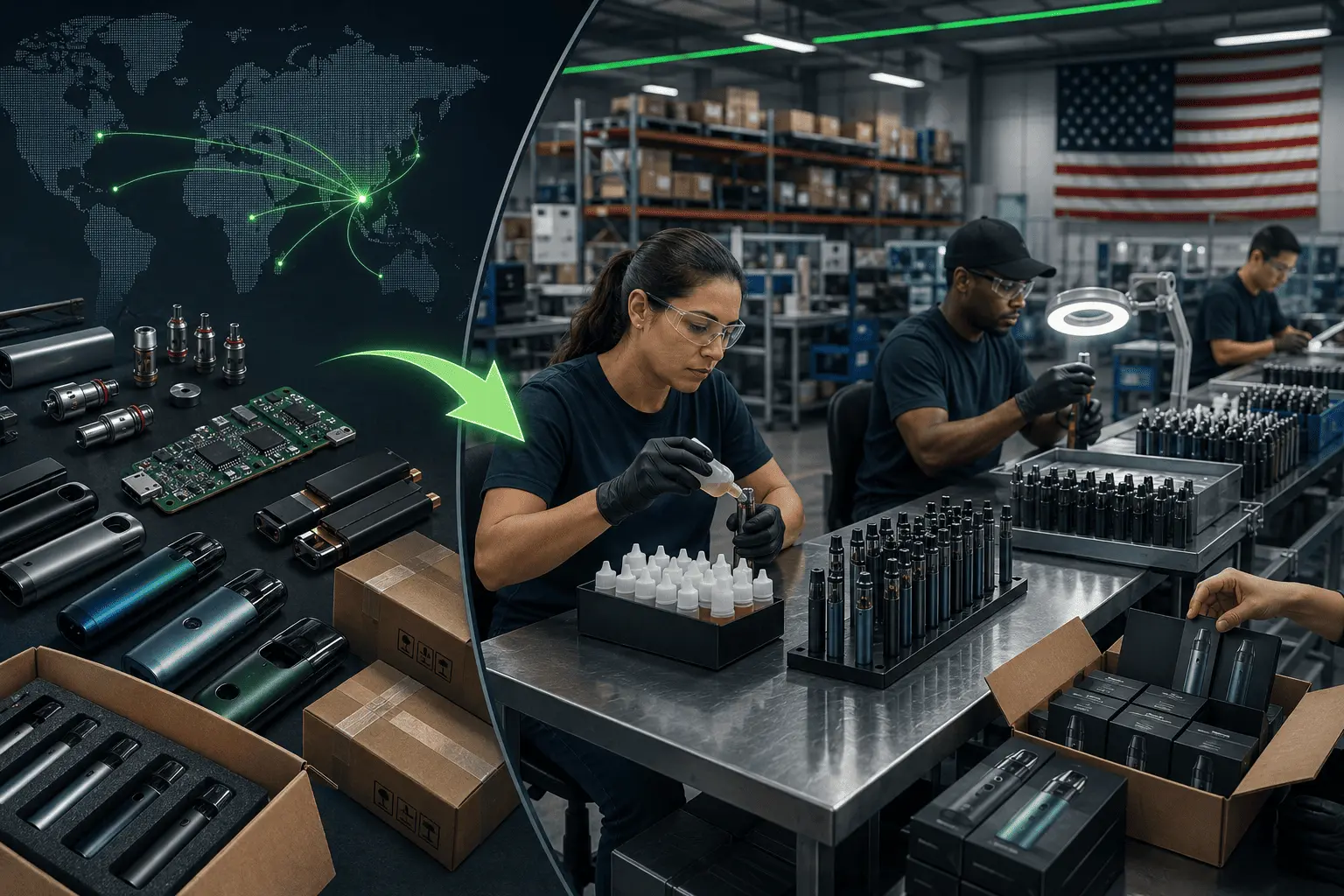
Since 2026, more US customers demand American-made vapes to satisfy regulatory requirements. But US vape manufacturing faces the same problem as Indonesia: an immature supply chain. Most "US-made" vapes still rely heavily on Chinese equipment and components.8
What "Made in USA" Actually Means
Here's what typically happens with a "US-manufactured" vape:
- The hardware — the device body, heating element, battery, and circuit board — is made in China.
- The equipment is shipped to the US.
- In the US, workers fill the devices with e-liquid and package them.
- The product gets labeled "Assembled in USA" or sometimes "Made in USA."
Strictly speaking, this is still Chinese manufacturing. The core components, the technology, and the design all originate in China. The US step is essentially filling and packaging.
Why True US Manufacturing Is Difficult
| Factor | US Reality | China Reality |
|---|---|---|
| Component suppliers | Almost none domestically | Thousands within short distance |
| Manufacturing expertise | Limited vape-specific experience | 13+ years of specialized knowledge |
| Labor costs | Very high | Competitive |
| Speed to market | Slow | Fast |
| Mold making | Outsourced (often to China) | Done locally in days |
I'm not saying it's impossible for the US to build a real vape manufacturing base. But it would take years of investment and development. Right now, the demand for "American-made" vapes is mostly about regulatory optics, not about actual manufacturing capability.
What Does This Mean for Vape Consumers?
No matter where your vape is manufactured, what matters most is the experience you get.
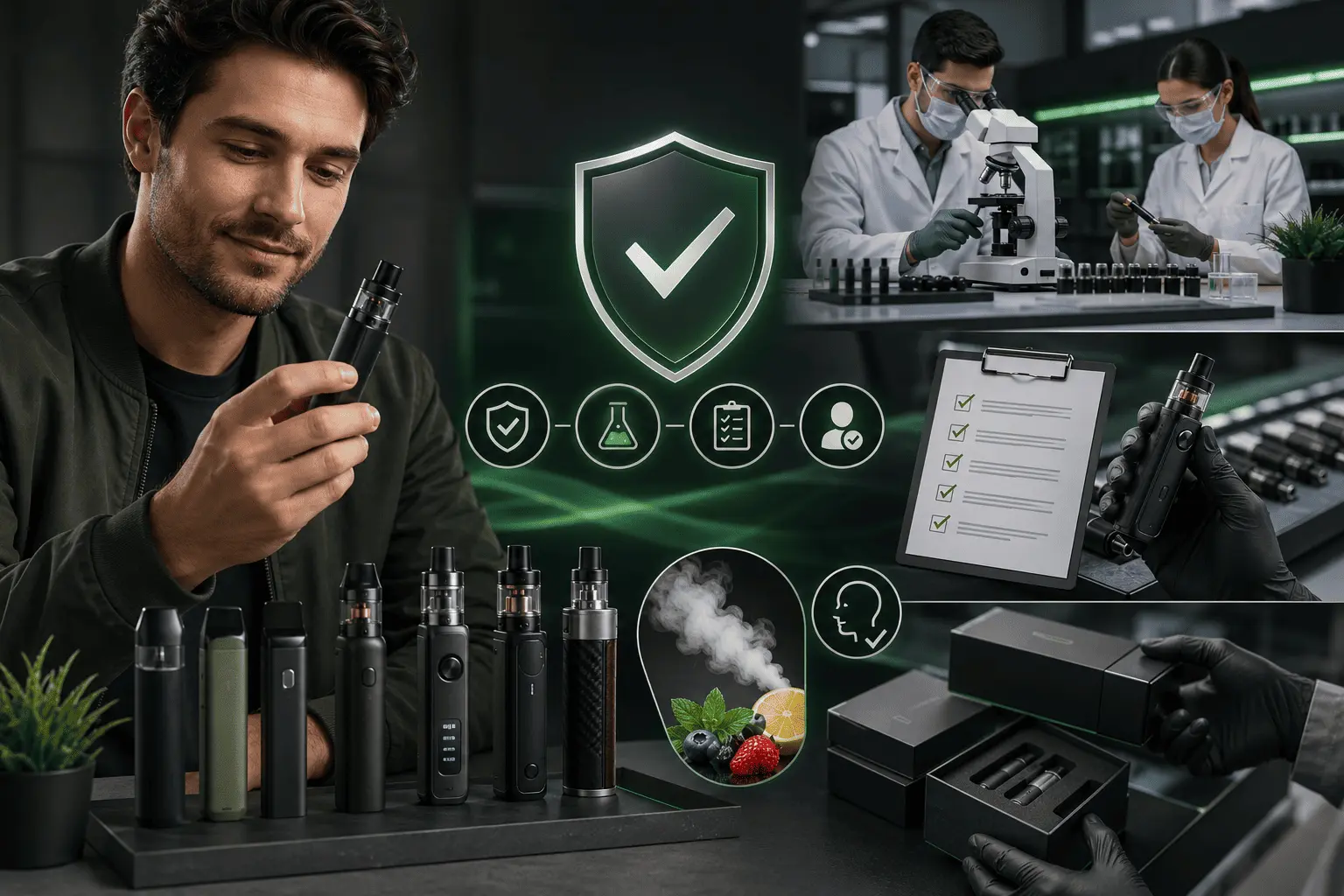
For consumers, the country of manufacture matters less than product quality, safety compliance, and vaping experience. A well-made vape from a reliable supply chain — wherever it's located — will always beat a poorly made local product.
Quality Over Origin
I've tested thousands of vapes over the years. Some of the best I've ever used came from small factories in Dongguan. Some of the worst came from companies with fancy branding and big marketing budgets.
What actually determines a good vape experience:
| Quality Factor | Why It Matters |
|---|---|
| Heating coil quality | Affects flavor and consistency |
| Battery reliability | Determines device lifespan and safety |
| E-liquid formulation | Controls taste and throat hit |
| Build quality | Prevents leaking and malfunctions |
| Regulatory compliance | Ensures safety standards are met |
At GetVapePuff, we screen and test products daily. We work with factories that have proper licenses and proven track records. Whether our products ship from China, our EU warehouses, or our US hubs, the quality standard is the same.
Our Philosophy
I've been in this industry long enough to know one thing for certain: consumers don't care about supply chain politics. They care about a satisfying draw, good flavor, reliable battery life, and a device that doesn't leak in their pocket.
That's what drives us. No matter which country produces the vape, our job as industry professionals is to deliver the best possible vaping experience to our customers. That means rigorous sourcing, honest testing, and reliable delivery.
Conclusion
China remains the world's largest vape producer thanks to its unmatched supply chain. Other countries are trying to compete, but the gap is still wide. What matters most is product quality and your vaping experience.
"Electronic cigarette use in China: Awareness, prevalence and ... - PMC", https://pmc.ncbi.nlm.nih.gov/articles/PMC6662798/. International trade or public-health sources identify China as the leading source of e-cigarette and vaping-device manufacturing, with production share often inferred from export and industry-location data rather than from a complete global factory census. Evidence role: statistic; source type: institution. Supports: A neutral source should support that China accounts for the largest share of global vape or e-cigarette manufacturing or exports.. Scope note: Direct global production counts may be unavailable, so export share or documented factory concentration may be used as contextual evidence. ↩
"Electronic cigarette use in China: Awareness, prevalence and ... - PMC", https://pmc.ncbi.nlm.nih.gov/articles/PMC6662798/. Studies of the e-cigarette industrial cluster in Guangdong describe Shenzhen and Dongguan as central locations for vaping-device production, though such sources may document regional concentration rather than prove an exact worldwide factory majority. Evidence role: statistic; source type: research. Supports: A source should document the concentration of e-cigarette manufacturing firms in Shenzhen and Dongguan relative to other regions.. Scope note: Support may be contextual if the source gives cluster dominance without a precise global percentage. ↩
"A comprehensive content analysis of 104 Chinese electronic ... - PMC", https://pmc.ncbi.nlm.nih.gov/articles/PMC11503047/. Market and trade analyses report rapid growth in China's e-cigarette industry during the 2010s and early 2020s, providing historical context for describing 2013-2022 as a period of unusually fast expansion rather than independently validating the phrase 'golden decade.' Evidence role: historical_context; source type: research. Supports: A source should show rapid expansion of China's e-cigarette manufacturing, exports, or firm formation during the 2013-2022 period.. Scope note: The phrase 'golden decade' is interpretive; evidence can support the growth trend, not the rhetorical label. ↩
"The Impact of New Regulations on Prevention and Control of E ...", https://pmc.ncbi.nlm.nih.gov/articles/PMC11018711/. China's 2022 e-cigarette regulatory measures brought e-cigarettes under tobacco-monopoly administration and required relevant market participants to obtain licenses for regulated production, wholesale, or retail activities. Evidence role: general_support; source type: government. Supports: An official Chinese government or regulator source should state the licensing requirements introduced for e-cigarette production, wholesale, and retail activities.. ↩
"Research on the Ecological Deconstruction of E-Cigarette Industrial ...", https://www.mdpi.com/2071-1050/14/9/5606. Research on China's e-cigarette and electronics manufacturing clusters links the country's production advantage to dense supplier networks for components, tooling, assembly, and logistics, although it may not quantify 'most complete' as a formal global ranking. Evidence role: mechanism; source type: research. Supports: A source should explain how China's regional supplier networks and electronics manufacturing ecosystem support e-cigarette production.. Scope note: The source may support the supply-chain mechanism without directly proving that no other country has an equally complete supply chain. ↩
"List of electric vehicle battery manufacturers - Wikipedia", https://en.wikipedia.org/wiki/List_of_electric_vehicle_battery_manufacturers. International energy statistics identify China as the dominant location for lithium-ion battery-cell manufacturing capacity and several of the world's largest battery manufacturers, supporting the supply-chain relevance of Chinese battery production to rechargeable vaping devices. Evidence role: statistic; source type: institution. Supports: An energy or industry institution should show China's leading role in global lithium-ion battery production or battery-cell manufacturing capacity.. Scope note: Battery-sector data support the broader component-supply claim, not vape-specific battery procurement by every manufacturer. ↩
"China Cancels Export VAT Tax Rebates for Nicotine Inhalation ...", https://www.hangsen.com/blog-regulations/China-Cancels-Export-VAT-Tax-Nicotine-Inhalation-Products.html. Chinese tax or customs notices documenting changes to export value-added-tax rebate rates for e-cigarette products would support the claim that the export rebate was removed or reduced for vape manufacturers. Evidence role: general_support; source type: government. Supports: An official tax or customs source should state the rebate-rate change for e-cigarette or vape exports.. Scope note: The source should be checked for the exact product codes and effective dates, because rebate changes may apply only to specified tariff classifications. ↩
"Complying with the Made in USA Standard", https://www.ftc.gov/business-guidance/resources/complying-made-usa-standard. FTC guidance states that unqualified 'Made in USA' claims require products to be all or virtually all made in the United States, while import data showing substantial US sourcing of e-cigarette hardware from China provides contextual support for the claim that domestic assembly may still depend on Chinese components. Evidence role: definition; source type: government. Supports: A source should clarify US origin-labeling standards and, ideally, show the scale of US imports of Chinese vaping devices or components.. Scope note: FTC rules define labeling standards but do not by themselves prove the sourcing pattern of every US-marketed vape. ↩