
Worried your "Made in USA" vape isn't what it seems? You see the label but hear confusing rumors. I'll show you the real story behind where your vape is made.
The vast majority of vapes are not manufactured from scratch in the USA.1 While some final assembly and e-liquid filling happens stateside, the [core components, hardware, and mass production are almost exclusively based in China, specifically in the Shenzhen region.]2
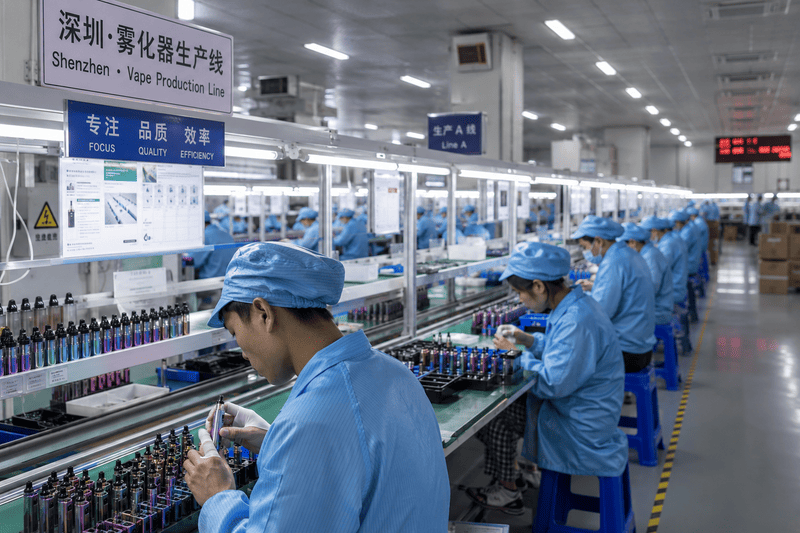
I get this question all the time from customers. It's confusing because you see American brands and "Made in USA" labels everywhere. But the reality of global manufacturing is a bit more complicated than a simple sticker. To really understand it, we need to look at where this industry started and how it grew. This will help you see the bigger picture and make smarter choices as a consumer. Let's dig into the details.
Where Did Vaping Manufacturing Actually Begin?
Curious about the roots of the vape you're holding? It feels like a modern global product. But its origin story is surprisingly concentrated in one specific place on the map.
Modern vaping manufacturing was born in China3, specifically in the Bao'an District of Shenzhen.4 This area became the "Silicon Valley of Vaping5," where the first factories were established and where the entire global supply chain for vape hardware took root and grew.
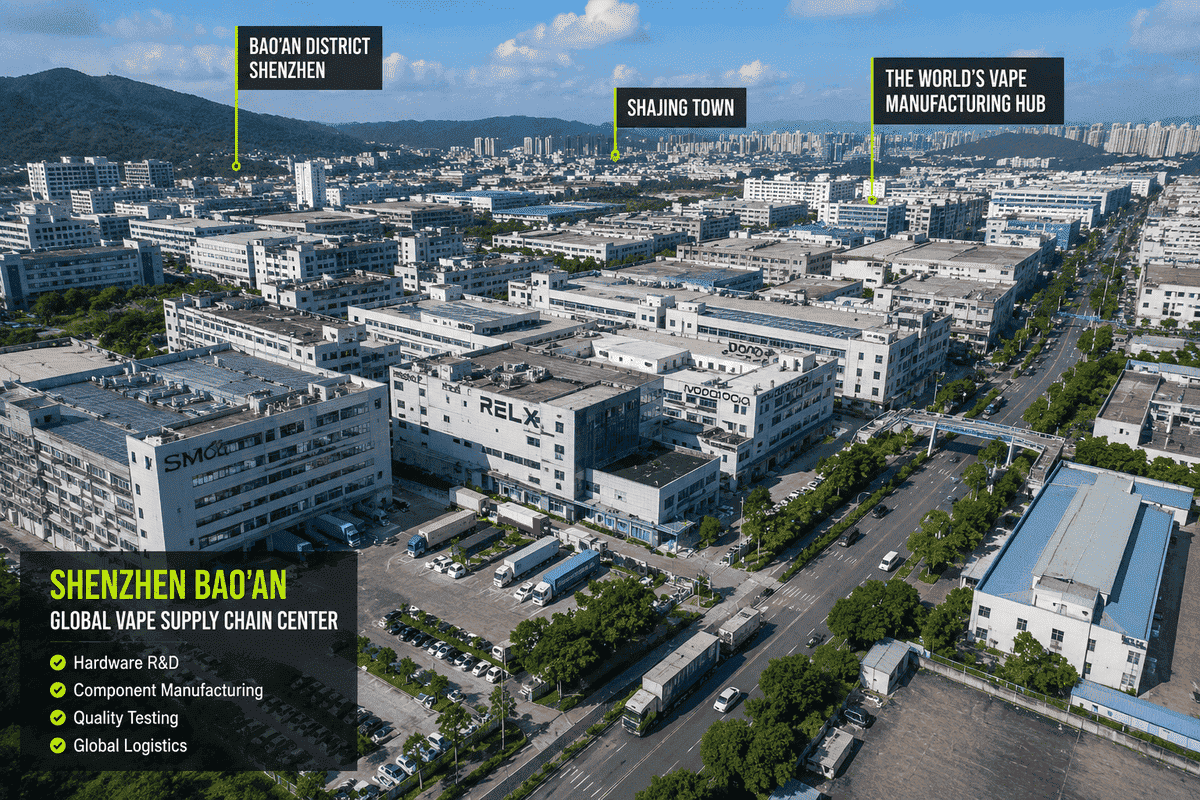
I remember my first sourcing trips to Shenzhen over a decade ago. It was already a buzzing hub of innovation. You could feel the energy. The district of Bao'an, and especially the town of Shajing, was ground zero. This wasn't a coincidence. Shenzhen was already a global center for electronics manufacturing.6 When the modern e-cigarette was invented, the infrastructure to build it was already there. Factories could quickly pivot from making cell phone parts to making vape components. As demand for vapes exploded around the world7, these factories grew. Soon, the towns of Shajing and Fuyong couldn't hold any more. The industry started spreading to nearby cities like Dongguan8, but Shenzhen remained the heart of it all.
The Shenzhen Ecosystem
What makes Shenzhen so unique is the complete ecosystem. It's not just about one factory making a vape. It's about thousands of specialized suppliers all located within a few square miles.9
| Component/Service | Availability in Shenzhen | Availability in the USA |
|---|---|---|
| Battery Suppliers | Hundreds of specialized factories | Very few, mostly for other industries |
| Microchip Producers | Dedicated teams designing vape-specific chips | General electronics, not specialized |
| Coil/Heating Elements | Mass production facilities with years of experience | Niche or hobbyist level |
| Skilled Labor | A massive workforce trained in electronics assembly | Expensive and limited |
| Logistics | World's busiest port, expert global shipping networks | High domestic shipping costs |
This concentration creates incredible speed and efficiency. I've seen a new vape design go from a concept sketch to a full production prototype in less than a week. That's just not possible anywhere else in the world.
What Was the Early US Vape Market Like?
Remember the early days of vaping? Shops popped up on every corner with endless e-liquid flavors. It felt like a truly American industry, but the hardware told a different story.
In the early days, the US market was a hybrid. It was defined by local vape shops and thousands of American-made e-liquid brands. However, the hardware—the actual devices, mods, and tanks—was almost always designed and manufactured in China before being imported.10
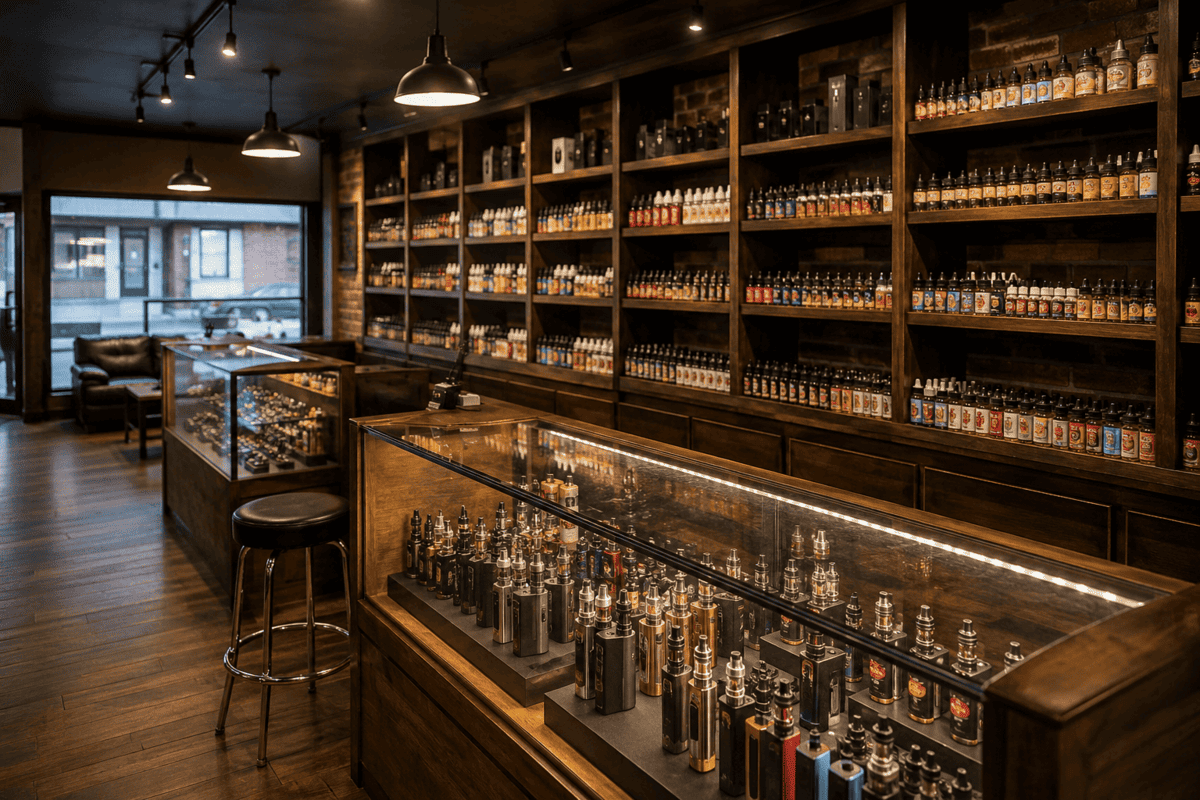
I recall walking into vape shops in California around 2014 and 2015. The walls were lined with colorful bottles of e-liquid from brands I'd never heard of, all made locally. It was a creative explosion. Shop owners and their customers were passionate about "mod culture." They would buy a powerful and complex mod box—made by a Chinese brand—and pair it with a specific tank from another Chinese company. Then, they'd fill it with a craft e-liquid made in a small lab just a few towns over. This created a clear division in the industry.
A Tale of Two Industries
The global vape market was split down the middle. China focused on what it did best: technology and mass production. The US focused on what it did best: branding, retail, and flavor creation. One couldn't exist without the other. This partnership fueled the growth of vaping for years.
| Role in Early Vaping | China's Focus | USA's Focus |
|---|---|---|
| Manufacturing | Hardware R&D, device production, tanks, coils | E-Liquid creation, flavor development |
| Innovation | More powerful chips, better batteries, new designs | Complex flavor profiles, nicotine salt formulas |
| Distribution | B2B exporting to global distributors | B2C retail through thousands of vape shops |
| Community | Online forums for hardware enthusiasts | Local vape meets, cloud chasing competitions |
This system worked well until disposable vapes changed the game. Suddenly, the hardware and the liquid were combined into a single, sealed product, shifting the entire manufacturing dynamic.
Why Don't Companies Just Build Vape Factories in the USA?
With rising shipping costs and regulations on imports, it seems logical to just make vapes in America, right? The idea is simple, but the reality is incredibly complex and expensive.
Building vape factories in the US is not currently feasible because the entire, highly specialized supply chain is located in China.11 From batteries and microchips to casings and coils, all the necessary component suppliers are clustered around Shenzhen. Recreating this ecosystem would be nearly impossible.
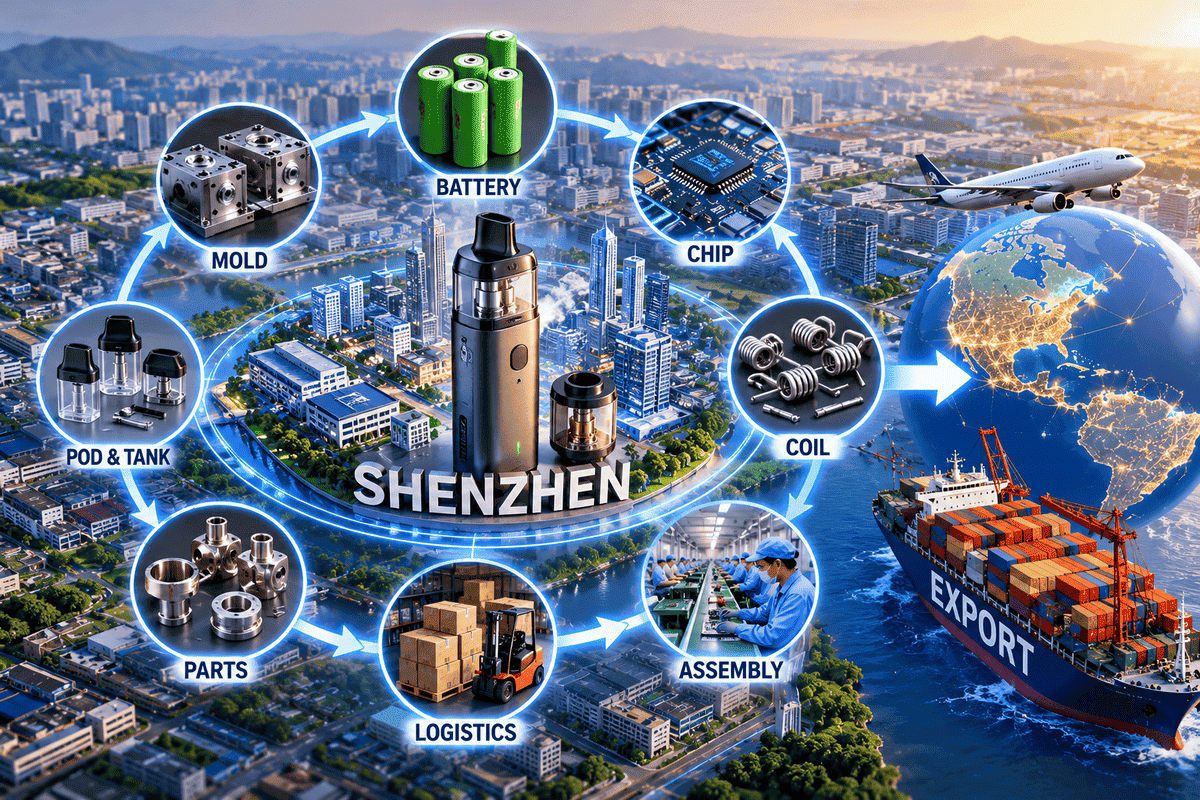
Think about trying to build a new smartphone from scratch in a country with no computer chip factories. You can't. The vape industry is the same. A disposable vape looks simple, but it contains dozens of specialized parts. In my work with GetVapePuff, I see this every day. We source from factories that have other factories right next door supplying them with the exact battery, heating element, or plastic shell they need. It’s a seamless network that has been built over 15 years. You can't just copy and paste that level of industrial concentration to another continent. The cost to even try would be astronomical, and the final product would be far too expensive for any consumer to buy.
The Unbeatable Supply Chain of Shenzhen
The sheer density of the supply chain in Shenzhen gives it an advantage that money alone can't replicate. If a factory needs a new part, they can get it delivered in hours, not weeks. This speed is critical in a fast-moving market like vaping.
| Manufacturing Factor | USA | China (Shenzhen) |
|---|---|---|
| Component Sourcing | Must import nearly every single part | Thousands of local suppliers |
| Skilled Labor | High-cost, limited pool for electronics | Massive, affordable, and highly experienced |
| Production Cost | Extremely high | Extremely low due to scale and efficiency |
| Speed to Market | Months or years to set up | Weeks from idea to finished product |
Because of these factors, even if a company wanted to build a true "Made in USA" vape, they would still have to import 99% of the parts from China, which defeats the entire purpose.
So What Does 'Assembled in the USA' Really Mean for Vapes?
You've probably seen vapes with labels like "Assembled in USA" or "Filled in USA." This sounds promising, but what part of the process is actually happening here?
For vapes, "Assembled in the USA" or a similar label typically means only the very last steps are done stateside.12 Empty, pre-made devices are imported in bulk from China, then filled with e-liquid and placed into their final packaging in a US-based facility.

This practice became more common as regulations on vape imports tightened. It's both a marketing strategy and a way to manage logistics. I've spoken with brand owners who do this. They receive huge shipments of "empties"—fully assembled but unfilled disposable vapes. Their US facility is essentially an e-liquid lab and a packaging line. They inject the e-liquid into the devices and then put them into the boxes you see on the shelf. In some cases, the e-liquid itself is also made in bulk in China and shipped over in large containers. So, the "American" part is often just the final step of putting liquid in a pod and the pod in a box.
The Final Step: Filling and Packaging
This process is more about final-stage customization and logistics than true manufacturing. It allows brands to have more control over their flavor profiles and respond to local market tastes, but it doesn't change where the device itself was born. The journey of your vape is a global one.
| Manufacturing Stage | Location | Description |
|---|---|---|
| Step 1: Component Sourcing | China | Batteries, coils, chips, and casings are made. |
| Step 2: Device Assembly | China | The empty vape device is fully assembled in a factory. |
| Step 3: Bulk Shipping | From China to USA | Thousands of empty devices are shipped across the ocean. |
| Step 4: E-Liquid Filling | USA | The imported empty devices are filled with e-liquid. |
| Step 5: Final Packaging | USA | The filled device is placed in its retail box and sealed. |
So, while the last hands to touch your vape might be in the USA, its entire life story before that point took place on the other side of the world.
Conclusion
In short, while some final filling and packaging happens in the USA, true vape manufacturing remains firmly rooted in China's mature, efficient, and deeply integrated supply chain. For global retailers and distributors, working with a reliable vape wholesale partner provides access to stable supply, diverse products, and professional sourcing support.
"USITC Institutes Section 337 Investigation of Certain Disposable ...", https://www.usitc.gov/press_room/news_release/2026/er0226_68219.htm. Government import statistics for electronic nicotine delivery system hardware identify China as a major source of devices entering the United States, supporting the claim that much US-market vape hardware is imported rather than manufactured domestically from scratch. Evidence role: statistic; source type: government. Supports: Government trade data showing that the United States imports a large volume of e-cigarette or vaping-device hardware, with China as a dominant source.. Scope note: Trade data show cross-border flows of finished or classified goods, but they may not capture every domestic assembly operation or private-label production arrangement. ↩
"[PDF] Federal Regulation of E-cigarettes and the Rise of Juul and Puff Bar", https://www.hsgac.senate.gov/wp-content/uploads/2024-02-29-PSI-E-cig-Report-Appendix.pdf. Research on China's e-cigarette manufacturing sector describes a concentrated hardware supply chain in Shenzhen and the surrounding Pearl River Delta, supporting the article's characterization of the region as central to mass vape production. Evidence role: general_support; source type: research. Supports: A neutral study or institutional report describing Shenzhen and nearby Pearl River Delta cities as a major e-cigarette manufacturing cluster.. Scope note: Such sources usually document regional concentration rather than proving that production is 'almost exclusive' worldwide. ↩
"Hon Lik - Wikipedia", https://en.wikipedia.org/wiki/Hon_Lik. Historical summaries of electronic cigarettes commonly trace the modern device to Hon Lik's early-2000s invention in China, providing context for the industry's Chinese manufacturing origins. Evidence role: historical_context; source type: encyclopedia. Supports: A historical account identifying the modern electronic cigarette with Chinese inventor Hon Lik and early Chinese commercialization.. Scope note: This supports the origin of the modern e-cigarette device, not necessarily the full later geography of mass manufacturing. ↩
"E-Cigarette Industrial Clusters in Shenzhen - Encyclopedia.pub", https://encyclopedia.pub/entry/23502. Institutional descriptions of Shenzhen's e-cigarette industry identify Bao'an District, including manufacturing towns such as Shajing, as a notable concentration of vape-device producers. Evidence role: case_reference; source type: institution. Supports: An institutional, municipal, or industry-cluster source identifying Bao'an, including Shajing or nearby towns, as a concentration of e-cigarette manufacturers.. Scope note: District-level sources may document present or recent clustering rather than conclusively establishing the exact birthplace of all modern vape manufacturing. ↩
"About Us - China Disposable Vape Manufacturers Suppliers", https://www.vapmr.com/about-us. Contemporary accounts have used the phrase 'Silicon Valley of Vaping' for Shenzhen because of its dense concentration of e-cigarette firms, suppliers, and electronics capabilities. Evidence role: historical_context; source type: other. Supports: A neutral source using the nickname to describe Shenzhen's concentration of vaping firms and suppliers.. Scope note: A nickname reflects common characterization rather than a formal statistical classification. ↩
"A History of the Electronics Industry in Shenzhen, China | umsi", https://www.si.umich.edu/about-umsi/events/military-industrial-complex-global-supply-chain-history-electronics-industry. Reference works on Shenzhen describe the city as a major electronics manufacturing and technology hub, supporting the article's explanation that vape production emerged within an existing electronics ecosystem. Evidence role: historical_context; source type: encyclopedia. Supports: An encyclopedic or academic source describing Shenzhen's transformation into a major electronics manufacturing center.. Scope note: This establishes Shenzhen's broader electronics role, not the specific operational history of individual vape factories. ↩
"Estimation of the global number of e-cigarette users in 2020 - PMC", https://pmc.ncbi.nlm.nih.gov/articles/PMC8541798/. International public-health reporting has documented the rapid spread and increasing availability of electronic nicotine delivery systems in many countries, supporting the article's description of growing global demand. Evidence role: statistic; source type: institution. Supports: International public-health or market data showing rapid growth in e-cigarette availability, use, or sales across countries.. Scope note: Public-health sources often measure prevalence and availability rather than factory order volumes directly. ↩
"[PDF] December 2, 2024 Dongguan Delin Technology Co. Ltd. No. 3 ...", https://democrats-selectcommitteeontheccp.house.gov/sites/evo-subsites/democrats-selectcommitteeontheccp.house.gov/files/evo-media-document/Letter%20to%20Dongguan%20Delin%20Technology.pdf. Regional supply-chain studies of the Pearl River Delta note e-cigarette manufacturers and suppliers in Dongguan alongside Shenzhen, supporting the claim that the industry extended into nearby cities. Evidence role: case_reference; source type: research. Supports: A regional industry or supply-chain source indicating that e-cigarette manufacturers and suppliers operate in Dongguan as well as Shenzhen.. Scope note: Evidence of firms in Dongguan supports regional spread, but may not establish the precise timing or sequence of that expansion. ↩
"E-Cigarette Industrial Clusters in Shenzhen - Encyclopedia.pub", https://encyclopedia.pub/entry/23502. Cluster-level reporting on Shenzhen's e-cigarette industry estimates a large concentration of related firms and suppliers in and around Bao'an, supporting the article's point about unusually dense supplier proximity. Evidence role: statistic; source type: institution. Supports: An industry-cluster or municipal source estimating the number of e-cigarette-related firms and suppliers concentrated in Shenzhen or Bao'an.. Scope note: Available counts may cover registered firms across a district or city rather than suppliers literally located within only a few square miles. ↩
"Electronic cigarette use in China: Awareness, prevalence and ...", https://pmc.ncbi.nlm.nih.gov/articles/PMC6662798/. Studies of the e-cigarette market describe China as a principal manufacturing source for device hardware sold internationally, supporting the article's distinction between US e-liquid branding and imported hardware. Evidence role: general_support; source type: paper. Supports: A scholarly or policy source describing China as the main manufacturing base for e-cigarette hardware sold in the United States.. Scope note: The evidence may support predominance rather than the stronger phrase 'almost always' for every category of early US hardware. ↩
"Do China's e-cigarette control policies work? A decade-long ... - PMC", https://pmc.ncbi.nlm.nih.gov/articles/PMC12465113/. Research on industrial clusters shows that dense supplier networks can reduce lead times and production costs, which provides a mechanism for why relocating vape manufacturing away from Shenzhen's established supply chain would be difficult. Evidence role: mechanism; source type: research. Supports: Research explaining how dense industrial clusters reduce sourcing time, transaction costs, and production barriers, with Shenzhen as an electronics example.. Scope note: This provides contextual support for feasibility constraints rather than a direct cost model proving that US vape factories cannot be built. ↩
"Complying with the Made in USA Standard", https://www.ftc.gov/business-guidance/resources/complying-made-usa-standard. Federal Trade Commission guidance distinguishes qualified 'Assembled in USA' claims from broader 'Made in USA' claims and states that assembly claims depend on the location and significance of final assembly, supporting the article's distinction between final-stage processing and full domestic manufacture. Evidence role: definition; source type: government. Supports: FTC guidance distinguishing unqualified 'Made in USA' claims from qualified assembly claims and explaining that assembly claims relate to where principal assembly occurs.. Scope note: FTC guidance defines labeling standards generally; it does not by itself prove how every vape brand uses the label in practice. ↩